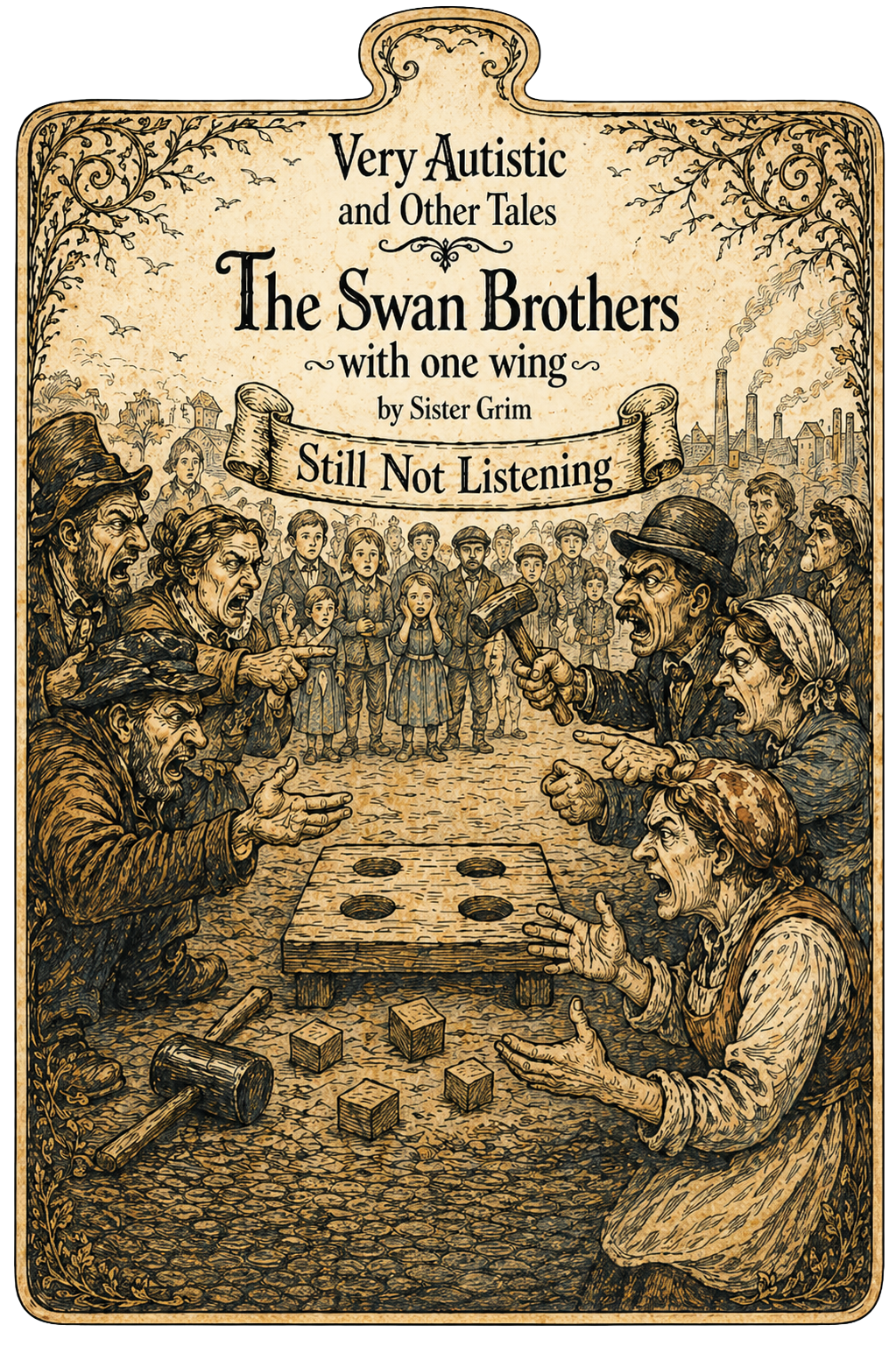
This is the third in a series of companion documents responding to Litman et al. (2025), Nature Genetics. The full methodological critique is in The Brother With the Wing. The plain-language guide is in What They Actually Did.
This document is about who called it groundbreaking, who said it could cut support, and why the argument about who speaks for autism is forty years old — even if Autism Speaks is only twenty-one.
Two Organisations. One Paper. Two Responses.
In July 2025 a paper was published in Nature Genetics by researchers at Princeton University and the Simons Foundation. It claimed to have identified four biologically distinct subtypes of autism — each with its own genetic program, each pointing toward precision medicine and personalised care.
Autism Speaks called it groundbreaking.
The National Autistic Society said it had no current clinical value and could be used to cut support to people who need it.
Those two responses tell you more about this paper than the paper's abstract does. They tell you whose interests autism research has historically served. They tell you who was in the room when this paper was designed. And they tell you why the same argument keeps having to be made, decade after decade, by the same people who were not asked.
What Autism Speaks Is
Autism Speaks was founded in 2005. For the first decade of its existence it had no autistic people on its board. Its founding campaigns described autism as a tragedy, a kidnapping, a disease stealing children from their families. Its 2009 documentary I Am Autism included the line: "I know where you live. And you are not alone at 2 in the morning when your spouse is running down the street in terror."
The autistic community documented these problems from the beginning. Autistic self-advocates. Parents of autistic children. Disability rights organisations. The response from Autism Speaks was consistent: the science comes first. The biology matters. We are working toward treatments and cures.
Autism Speaks has evolved. It has added autistic board members. It has changed some language. It no longer uses cure language openly. But on the fundamental question — whether research classifying autistic people should include autistic people in its design — the pattern holds.
The Litman paper did not include autistic people in its design. The instruments were chosen without autistic input. The classes were built without autistic input. The names were chosen without autistic input.
What the NAS Is
The National Autistic Society was founded in 1962 by a group that included autistic people and their families. It has autistic people embedded in its governance. It represents autistic people and their families in the UK. Its mission is explicitly led by the principle that autistic people are the experts on autism.
When the Litman paper was published the NAS reviewed it and said: this classification has no current clinical value and could be used to cut support to people who need it.
That response did not come from a methodological dispute. It came from an organisation with autistic governance knowing — from decades of watching how classification systems operate in practice — that a tiering mechanism with no class-specific interventions does one thing in underfunded support systems. It tells some people their challenges are moderate. And when support is rationed, moderate means less.
Nothing About Us Without Us Is Not A Slogan
Nothing About Us Without Us is the foundational principle of the disability rights movement. It means disabled people must be included in decisions that affect them. It is embedded in the United Nations Convention on the Rights of Persons with Disabilities as Article 4.3 — a legal obligation requiring that research classifying disabled people include those people in its design.
The autistic community has been saying this since before there was an organised autistic community to say it. Temple Grandin. Jim Sinclair. Judy Singer. Donna Williams. Every generation of autistic advocates has made the same argument: you cannot understand autism from the outside. You cannot design instruments to measure it without the people you are measuring. You cannot name classes without asking the people in them what those names mean when they travel into the rooms of their lives.
The Litman paper did not ask. There is no record of autistic community input into the instrument selection. No record of autistic input into the class naming. No record of autistic input into the clinical application language. The press release did not mention the community at all.
The Forty Year Argument
This is not a new disagreement. The argument about who speaks for autism — and whether autistic people are included in decisions about themselves — goes back at least forty years. Autism Speaks, founded in 2005, is the most prominent current example of an organisation that has consistently landed on the wrong side of it. But the argument predates Autism Speaks by decades.
In 1981 Lorna Wing — working from research by Grunya Efimovna Sukhareva that the field had ignored for fifty years — argued that autism existed across all levels of intellectual ability. That the children warehoused in institutions as feeble-minded and mentally defective were autistic. That the sorting had been wrong all along. The field resisted. The sorting had given the field clean categories to work with. Wing's argument complicated them.
In 1993 Jim Sinclair wrote Don't Mourn For Us — a letter to parents of autistic children that is still one of the clearest statements of what it means to have your existence framed as tragedy. The organisations that claimed to speak for autism responded by fundraising on exactly that framing.
In 2007 the Autism Self Advocacy Network was founded by autistic people, explicitly to counter the narrative that organisations like Autism Speaks were building. Nothing About Us Without Us. The organisations that claimed to speak for autism continued building it.
In 2013 the DSM moved from discrete autism subcategories to the spectrum — not because advocacy won an argument but because the research showed the categories were wrong. They were unreliable. They did not predict different outcomes. They created documented restrictions on service eligibility that harmed people at both ends. Children with Asperger's diagnoses were denied services in states that only funded Autistic Disorder. Children with Autistic Disorder labels lost educational opportunity because the label implied a ceiling. The evidence said the categories were not real. The harm was real. The DSM moved to spectrum.
In 2025 a paper published in Nature Genetics rebuilt the category structure the evidence already showed was harmful. It used better computers and biological language. It called the result a paradigm shift.
What The Paper Actually Found
The paper took 5,392 already-diagnosed autistic children from a research database called SPARK — itself funded by the Simons Foundation, which also funded this paper. It asked parents to complete three questionnaires built by researchers who had already decided what autism was. It fed those questionnaire responses into a free statistical software package called StepMix. The software found four groups in the data — as it will find groups in any data, because finding groups is what it does. Clinical collaborators from the same research tradition selected which grouping felt most interpretable. The researchers named the four groups Broadly Affected, Social/Behavioral, Mixed ASD with Developmental Delay, and Moderate Challenges.
They then ran genetic analysis on fewer than half the children — 2,294 of 5,392, white children only. They found that groups where parents ticked more boxes had higher average scores on genetic measures derived from other people's population data. They compared gene lists against a database of postmortem fetal brain tissue and found overlaps. They called these results biological programs. They called the four groups biologically distinct subtypes. Princeton issued a press release. The Simons Foundation issued a press release.
None of the four classes showed a statistically significant signal for the autism polygenic score. The genetic signals that differentiate the classes are for ADHD, IQ, educational attainment, and major depression — not autism itself. No biological test exists that places any child in any class. No class-specific interventions exist. No mechanism was identified. No therapeutic target was named.
The four names did not come from the data. They came from the same tradition that built the instruments. Broadly Affected is severe with a Princeton algorithm behind it. Severe was the language the community spent decades contesting because it told systems what a person could not do before anyone checked what they could. Social/Behavioral is the behavioral deficit framing the community has been fighting since the 1990s — it locates the problem in the autistic person's conduct rather than in the environment or the mismatch.
The NAS said this classification has no current clinical value and could be used to cut support to people who need it.
Why It Matters Who Calls Things Groundbreaking
Autism Speaks has significant institutional power. It funds research. It shapes policy conversations. It has the ear of legislators and insurers and school systems. When Autism Speaks calls something groundbreaking, that word travels into rooms where decisions about autistic people's lives are made. It enters clinical conversations before the methodology does. It enters IEP meetings before the family does. It enters funding decisions before the evidence does.
The NAS has built significantly more trust within the autistic community than Autism Speaks — not uncritically, but because of how it is structured and governed. It has decades of watching how classification systems operate in practice. When the NAS says something could cut support, that is not a theoretical concern. It is pattern recognition from an organisation that has watched support tiers built, watched them harm people at both ends, and watched the field rebuild them with better language and call it progress.
The autistic people who looked at this paper and named what it was — a tiering mechanism dressed in genetic language, rebuilding categories the evidence already showed were harmful, designed and named without asking the people being classified — those people were not wrong. They were doing what the community has always done. Telling the field what it cannot see from the outside.
The field was not listening in 1981. It was not listening in 1993. It was not listening in 2007. The DSM listened in 2013 — not to the community, to the evidence. And now in 2025 a paper rebuilds what the evidence dismantled and a major organisation calls it groundbreaking.
The NAS is still saying what it has always said. The community is still saying what it has always said.
What You Can Do With This
If you are a clinician who has read this paper or seen it cited: the full methodological critique is in The Brother With the Wing. The methodology does not support the clinical application language. Before you apply this classification in practice you should know what the evidence actually shows and what it does not.
If you are a family member who has been handed one of these labels or expects to be: What They Actually Did explains in plain language what the study did step by step, what the genetic findings actually mean, and what the label is and is not based on. You have a right to that information before anyone uses a label in a room about your child.
If you are a researcher in this field: the argument in The Brother With the Wing is documented and sourced. It engages the methodology on its own terms. If there are errors in that argument they should be identified and corrected. If there are not, the field owes the community a response that matches the rigour of the critique.
If you are a policy maker or funder: the DSM-5 shift happened because the evidence showed discrete autism categories were unreliable, had poor predictive power, and created documented service restrictions that harmed people at both ends. The evidence that drove that shift has not changed. A classification system that rebuilds those categories requires a much higher evidentiary bar than this paper clears before it enters policy and funding decisions.
If you are a journalist: two organisations read the same paper. One called it groundbreaking. One said it could cut support to people who need it. That is a story about who speaks for autism, who funds autism research, and what happens to the people being classified when those two things are the same organisation. The documentation is in three companion papers from the Human Support Network.
Still Not Listening is the third in a series of companion documents produced by the Human Support Network in response to Litman, Sauerwald et al. (2025), "Decomposition of phenotypic heterogeneity in autism reveals underlying genetic programs," Nature Genetics, Volume 57, July 2025.
- The Brother With the Wing — full technical and legal critique
- What They Actually Did — plain language guide
- Still Not Listening — institutional and historical context
Sister Grim — Very Autistic and Other Tales / Human Support Network — April 2026